
What Is the Difference Between Ayurveda and Unani Medicine?
Introduction
An increasing number of people today are pursuing mild, safe natural health solutions rooted in ancient wisdom. Two traditional healing systems that have been passed down for centuries and trusted by millions of people globally to this day—Ayurveda and Unani medicine—are gaining widespread attention. Many people now want to understand the difference between Ayurveda and Unani medicine to choose the right natural healing method for their health needs.
Both fall under the umbrella of natural healing, yet they have many differences in their origins, core concepts, and treatment methods. Clarifying these differences can help the general public choose health solutions that truly fit their personal needs.
Ayurveda: The Ancient Indian Healing System
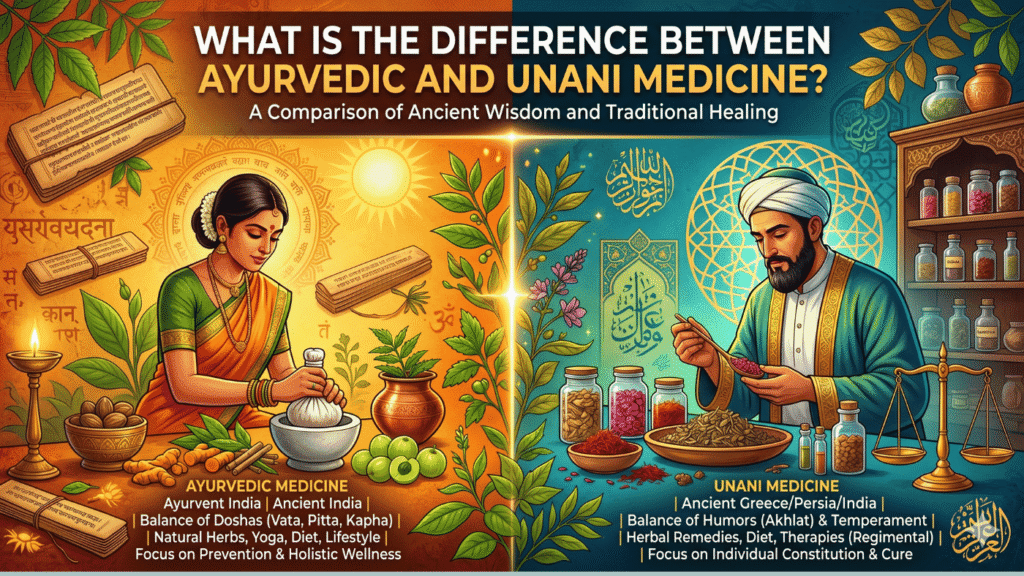
Ayurveda originated in ancient India, with a development history of more than 5,000 years. Its name comes from Sanskrit, and its original meaning is “knowledge of life.”
Its core theory holds that the balance of body, mind, and spirit is the foundation of health. The human body contains three energies (doshas):
- Vata
- Pitta
- Kapha
Any imbalance of these energies will trigger a range of health problems.
Treatment Methods in Ayurveda
Its treatment methods include:
- Herbal regulation
- Customized healthy diets
- Yoga
- Meditation
- Massage therapy
- Lifestyle adjustments
Its core proposition is to intervene early before diseases worsen, prioritizing prevention.
Unani Medicine: The Greco-Arabic Healing Tradition
Unani medicine originated in ancient Greece, with a history of more than 2,500 years. It later gradually spread to Persia, Arabia, and South Asia. Its name originally means “Greek.”
Hippocrates and Ibn Sina are the core figures that promoted its development. The Canon of Medicine written by Ibn Sina has even been used as the core guide for Unani treatment for hundreds of years.
The core logic of bodily balance for this system was first proposed by ancient Greek scholars, then supplemented with local medical knowledge by Arab and Persian scholars. It became widely popular in India during the Mughal period, and is still in use in many countries including India to this day.
Core Theory of Unani Medicine
Its core theory centers on the four humors:
- Blood
- Phlegm
- Yellow bile
- Black bile
It holds that balanced humors maintain health, while imbalanced humors cause diseases.
Treatment Methods in Unani Medicine
The history of Unani medicine dates back more than 2,500 years to ancient Greece. It was later developed by Arab and Persian scholars and introduced to India during the Mughal period. Famous physicians like Hippocrates and Ibn Sina played an important role in shaping this traditional healing system. Unani medicine history is deeply connected with natural healing, herbal remedies, and the belief that balancing the body’s four humors helps maintain good health.
Its treatment methods include:
- Herbal medicine
- Natural therapies
- Healthy diets
- Exercise
- Detoxification therapies
Core Differences Between Ayurveda and Unani Medicine
Next, we will systematically break down the core differences between the two systems from three dimensions:
1. Origin
- Ayurveda originated in ancient India.
- Unani medicine originated in ancient Greece and later developed in Persia and Arabia.
2. Core Theory
- Ayurveda focuses on the balance of the three doshas.
- Unani medicine focuses on balancing the four humors.
3. Treatment Type
- Ayurveda uses yoga, meditation, herbal regulation, and lifestyle management.
- Unani medicine mainly uses herbal therapies, natural remedies, and detoxification methods.
Similarities Between Ayurveda and Unani Medicine
As a traditional healing system derived from Greco-Arabic medicine, Unani’s core health logic revolves around the balance of the four humors. Rooted in ancient Indian culture and developed from ancient Sanskrit scriptures, Ayurveda’s core goal is to achieve the dynamic balance of the body, mind, spirit, and the three doshas.
The two systems hold several core commonalities:
- Both adopt a natural healing path that uses natural ingredients in place of potent chemical drugs.
- Both follow a prevention-first logic centered on sustaining healthy habits.
- Both provide personalized treatment plans tailored to individual constitutions.
- Both list exercise, sleep, diet, and stress management as core supporting elements for health maintenance.
Why These Traditional Systems Still Matter Today
Today’s high-pressure, busy modern populations are widely troubled by sub-health issues including poor sleep, weak digestion, chronic pain, and long-term fatigue.
These traditional systems do not pursue short-term symptom relief, but instead focus on long-term health maintenance. Over time, they have evolved into balanced lifestyles adapted to the pace of modern life.
Conclusion
Fundamentally, the core of both ancient healing systems is the concept of balance. To this day, they still help the general public make informed health choices and carry practical guiding significance that transcends eras.
According to the Ministry of AYUSH and the World Health Organization (WHO), traditional healing systems like Ayurveda and Unani medicine continue to play an important role in natural healthcare. These systems focus on prevention, balance, and overall wellness, helping people better understand the difference between Ayurveda and Unani medicine and their long-term health benefits.