
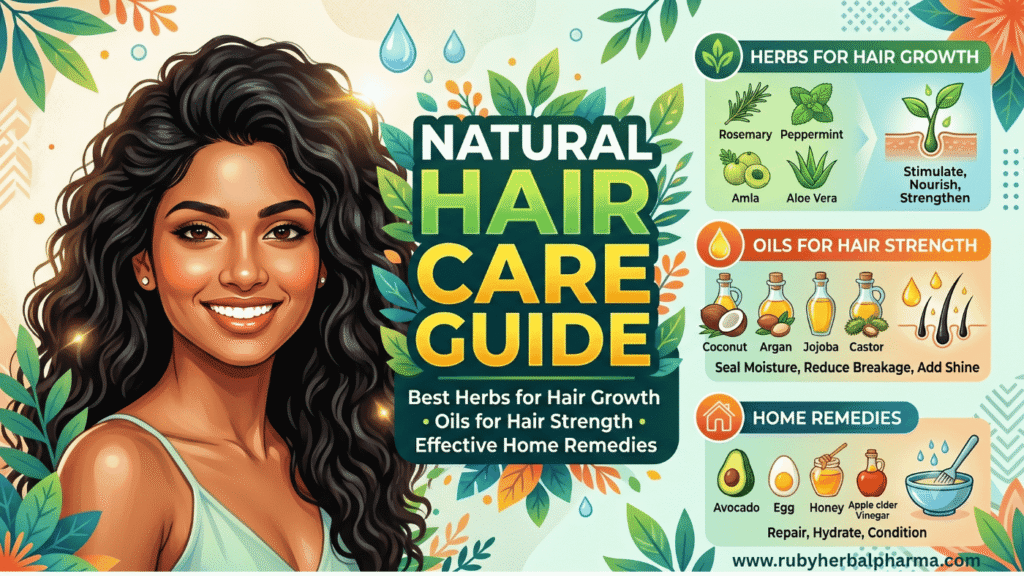
Natural Hair Care Guide: Best Herbs for Hair Growth, Oils for Hair Strength, and Home Remedies
Introduction
Healthy hair is often seen as a sign of good overall health. Hair can affect confidence, appearance, and self-esteem. Many people face common hair problems such as hair fall, dandruff, dryness, frizz, split ends, thinning hair, and scalp irritation.
Today, the market is full of shampoos, serums, masks, and treatments. While many products can be useful, natural hair care remains popular because it focuses on simple ingredients such as herbs, oils, and traditional home remedies.
This Natural Hair Care Guide explains how to take care of hair naturally. It covers the best herbs for hair growth, the best hair oil for hair growth, useful home remedies, and tips for choosing hair products for Indian hair.
The goal of this guide is educational. It does not replace professional medical advice. If hair loss is severe or sudden, consult a qualified healthcare professional.
Understanding Hair Structure
Before learning about hair care, it is important to understand how hair grows.
Each strand of hair has three main layers:
1. Cuticle
The outer protective layer of the hair shaft.
2. Cortex
The middle layer that gives hair strength, texture, and color.
3. Medulla
The innermost layer found in thicker hair strands.
Hair grows from follicles located beneath the scalp. Every follicle goes through different growth stages.
Hair Growth Cycle
Anagen Phase
The active growth stage. Hair can grow for several years during this phase.
Catagen Phase
A short transition phase.
Telogen Phase
The resting phase before hair naturally sheds.
It is normal to lose around 50–100 hairs daily as part of the natural cycle.
Why Natural Hair Care Matters
Natural hair care focuses on supporting the scalp and hair using gentle methods.
Benefits may include:
- Reduced exposure to harsh chemicals
- Better scalp health
- Improved moisture balance
- Reduced breakage
- Healthier-looking hair
- Easier long-term maintenance
Natural hair care works best when combined with:
- Good nutrition
- Proper sleep
- Stress management
- Regular scalp care
- Consistent routines
How to Take Care of Hair Naturally
Many people ask, “How to take care of hair properly?”
The answer involves a complete routine.
Keep Your Scalp Clean
A healthy scalp creates a better environment for hair growth.
Wash your scalp regularly according to your hair type.
Oily Hair
Wash more frequently.
Dry Hair
Wash less often and focus on moisturizing.
Normal Hair
Maintain a balanced schedule.
Avoid Excessive Heat
Frequent use of:
- Hair dryers
- Curling irons
- Straighteners
can damage hair proteins.
Try air drying whenever possible.
Protect Hair from Sun Damage
Strong sunlight may cause dryness and damage.
Protect hair using:
- Hats
- Scarves
- Umbrellas
during long outdoor exposure.
Stay Hydrated
Water supports overall body functions.
Proper hydration may help maintain scalp health and hair quality.
Trim Split Ends
Regular trimming helps:
- Reduce split ends
- Improve appearance
- Prevent further breakage
Avoid Tight Hairstyles
Very tight hairstyles can stress hair follicles.
Examples include:
- Tight ponytails
- Tight buns
- Tight braids
Repeated tension may contribute to hair loss.
Best Herbs for Hair Growth
Traditional systems such as Ayurveda have used herbs for hair care for centuries.
Amla (Indian Gooseberry)
Amla is one of the most famous herbs used for hair.
Benefits of Amla
- Rich in antioxidants
- Contains vitamin C
- Supports scalp health
- Helps improve hair appearance
- May reduce dryness
How to Use
- Amla powder masks
- Amla oil
- Amla-infused hair packs
Bhringraj
Bhringraj is often called the “King of Herbs” for hair care.
Benefits
- Supports scalp nourishment
- Helps maintain healthy hair
- Commonly used in Ayurvedic oils
Usage
- Bhringraj oil
- Hair masks
- Herbal hair packs
Brahmi
Brahmi is known for its calming properties.
Benefits
- Helps nourish the scalp
- Supports healthy-looking hair
- Often combined with other herbs
Usage
- Brahmi powder
- Herbal masks
- Hair oils
Hibiscus
Hibiscus flowers are widely used in Indian hair care.
Benefits
- Helps condition hair naturally
- Supports scalp moisture
- Makes hair feel softer
Usage
- Hibiscus paste
- Hibiscus oil
- Hair rinse
Fenugreek (Methi)
Fenugreek seeds have long been used for scalp and hair care.
Benefits
- Rich in proteins
- Helps improve hair texture
- Supports scalp comfort
Usage
Soak seeds overnight and create a smooth paste.
Apply to scalp and hair.
Neem
Neem is famous for scalp cleansing.
Benefits
- Helps maintain scalp hygiene
- Supports healthy scalp conditions
- Commonly used for dandruff-prone scalps
Usage
- Neem powder
- Neem oil
- Neem water rinse
Aloe Vera
Aloe vera remains one of the most popular natural hair remedies.
Benefits
- Cooling effect
- Supports scalp hydration
- Helps reduce dryness
Usage
Apply fresh aloe vera gel directly to the scalp.
Best Hair Oil for Hair Growth
Oil massage has been a traditional practice in India for generations.
Although oil alone cannot guarantee hair growth, it may support scalp health and reduce breakage.
Coconut Oil
Coconut oil is among the best hair oils for Indian hair.
Benefits
- Deep conditioning
- Reduces protein loss
- Helps manage dryness
- Improves softness
Best For
- Dry hair
- Damaged hair
- Curly hair
Almond Oil
Almond oil contains beneficial fatty acids.
Benefits
- Helps smooth hair
- Supports shine
- Improves manageability
Bhringraj Oil
A traditional Ayurvedic hair oil.
Benefits
- Supports scalp nourishment
- Commonly used in hair care routines
Amla Oil
Amla oil combines the benefits of oiling with herbal nourishment.
Benefits
- Supports healthy scalp conditions
- Helps maintain hair quality
Sesame Oil
Sesame oil has been used traditionally in Ayurveda.
Benefits
- Moisturizing properties
- Useful for scalp massage
Castor Oil
Castor oil is thick and rich.
Benefits
- Helps coat hair strands
- Supports moisture retention
Because it is thick, many people mix it with coconut oil.
How to Apply Hair Oil Correctly
Many people use oil incorrectly.
Follow these steps:
Step 1
Take a small amount of oil.
Step 2
Warm it slightly.
Step 3
Apply to scalp using fingertips.
Step 4
Massage gently for 5–10 minutes.
Step 5
Leave for 1–2 hours.
Step 6
Wash with a mild shampoo.
Avoid excessive oiling for many days without washing.
Hair Products for Indian Hair
Indian hair often faces challenges due to:
- Pollution
- Hard water
- Humidity
- Heat
- Dust
Choosing suitable hair products is important.
Mild Shampoos
Look for:
- Gentle cleansing
- Balanced formulation
- Suitable scalp type
Avoid excessive washing.
Conditioners
Conditioners help:
- Reduce tangles
- Improve softness
- Reduce breakage
Apply mainly to hair lengths.
Hair Serums
Useful for:
- Frizz control
- Shine
- Smoother appearance
Hair Masks
Weekly hair masks may help:
- Improve moisture
- Enhance softness
- Support damaged hair care
Natural masks can include:
- Aloe vera
- Yogurt
- Amla
- Fenugreek
Common Causes of Hair Problems
Hair issues often result from multiple factors.
Poor Diet
Hair requires nutrients including:
- Protein
- Iron
- Zinc
- Vitamins
Stress
Stress can affect the normal hair growth cycle.
Managing stress may support overall hair health.
Hormonal Changes
Hormonal fluctuations may contribute to:
- Hair thinning
- Increased shedding
Scalp Conditions
Scalp issues may interfere with healthy hair growth.
Examples include:
- Dandruff
- Excess oil
- Irritation
Excessive Chemical Treatments
Repeated exposure to:
- Hair coloring
- Bleaching
- Chemical straightening
may weaken hair over time.
Conclusion
Natural hair care focuses on long-term scalp and hair health. Understanding how to take care of hair properly, choosing the best herbs for hair growth, using the best hair oil for hair growth, and selecting suitable hair products for Indian hair can help create a healthier hair care routine.
Remember that healthy hair usually comes from a combination of good nutrition, proper scalp care, gentle products, adequate sleep, hydration, and consistent habits. Natural remedies may support hair health, but results vary from person to person. Patience and consistency are essential for maintaining strong, healthy-looking hair.
Ministry of AYUSH – https://ayush.gov.in/ Central Council for Research in Ayurvedic Sciences (CCRAS) – https://ccras.nic.in/ National Medicinal Plants Board (NMPB) – https://nmpb.nic.in/ Pharmacopoeia Commission for Indian Medicine & Homoeopathy (PCIM&H) – https://pcimh.gov.in/ National AYUSH Mission – https://namayush.gov.in/